
Safety
Confidence, built safely.
Fire & Knives is built on helping young kids grow in confidence: exploring, trying things, and finding their own boundaries. Safety is woven through every part of that. Here is how.
Sequenced and staged.
The curriculum is sequenced. Kids first learn safety and how to use a tool, then move on to the next stage of tool use or fire building. Before shelter building, for example, kids learn how to safely carry and handle large sticks.
The ratio.
Seven kids to one instructor, with class sizes of ten to fourteen. Small enough that every instructor knows every kid's name, tendencies and limits.
The tools.
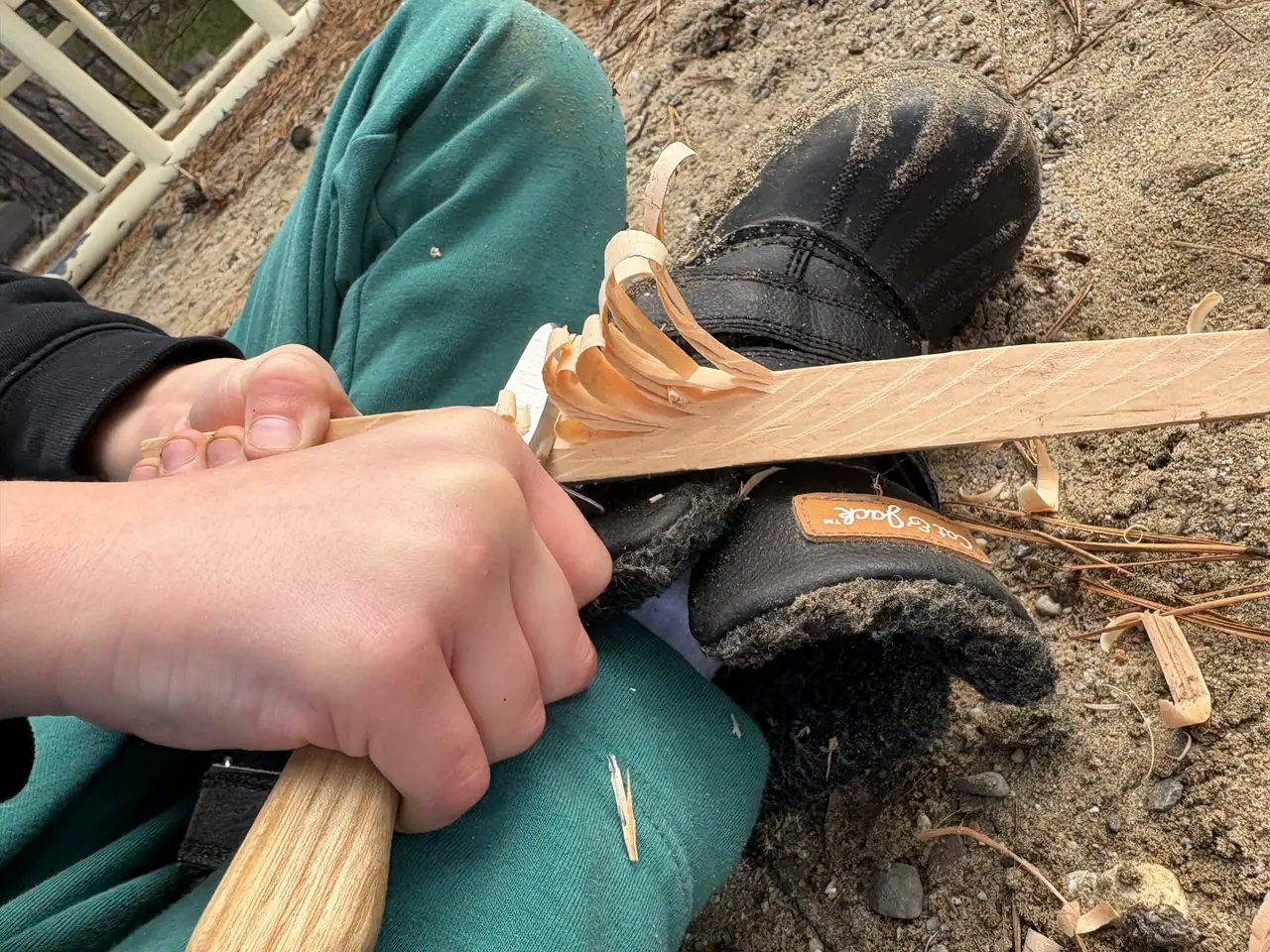
All tools are matched to age and skill level. Younger kids use rounded-tip knives, and practice tools sometimes come before anything sharp. Fires are lit with ferro rods. Every tool is counted out and counted back in, and nothing goes home.
The instructors.
Every instructor is background checked, and trained and certified in our curriculum before they work with a child. Every lead instructor is first aid and CPR certified, and instructors pass a skill demonstration before they lead that skill.
When something goes wrong.
We have an incident protocol and will walk any parent or school through it. We'd rather over-explain.
Where it comes from
Our curriculum and protocols draw on 25 years of combined experience in outdoor education, program building and risk management, and on industry best practices.
How we think about risk
Risk is a tool. We use it with care.
Every skill we teach carries some risk. Our philosophy is to use that risk as a tool for growth while keeping the chance of hurt or injury very low. We do it by setting clear boundaries and by building up each kid's own ability to assess and manage what is in front of them. That is where inner confidence and self-reliance come from: when a kid decides how close is too close, or checks whether a stick is safe to carry.
Risk and danger are not the same thing. Danger is a source of potential harm; risk is how likely harm is and how serious it could be. The outdoors comes with real risk, and our goal is not to eliminate it but to understand and manage it, through planning, supervision, procedure and judgment, so kids can learn, explore and take on meaningful challenges. Safety is never traded for speed, fun, or finishing an activity.
Where we aim
Too little challenge and kids are bored. Too much and they are anxious, or in over their heads. Instructors read the group for both, all class long, and adjust, so every kid spends the day in the sweet spot: real adventure, the idea of danger, and a well-managed setting.
Still have a question? Ask us directly!
Ask us directly